
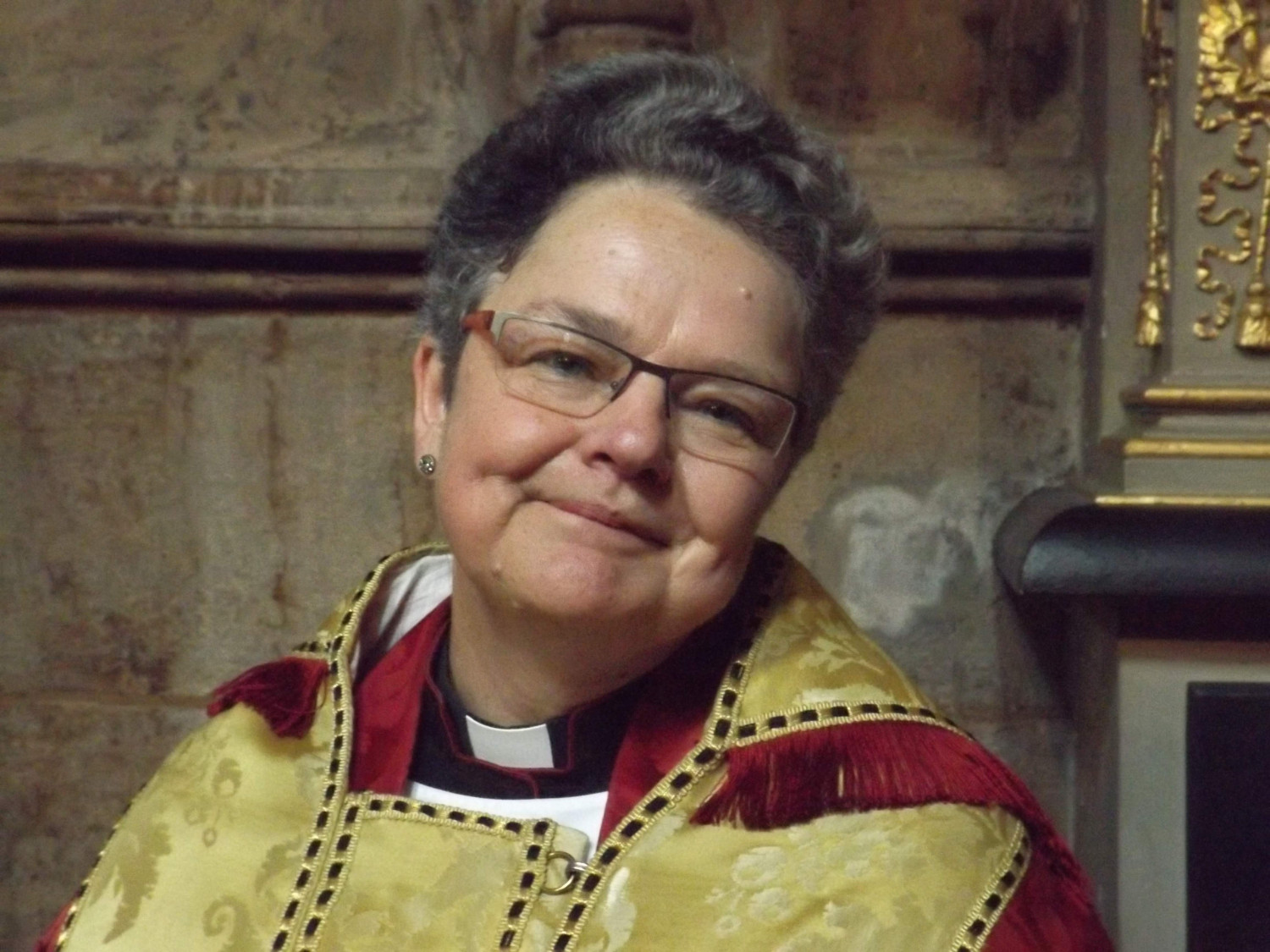
Sermon preached by the Very Revd Mandy Ford at Canterbury Cathedral, 14th December 2025
Listen to the sermon here – https://youtu.be/fTlIwYtjQuc?t=1694
I’m not cut out to be a prophet. As the old Kinks song goes, “I’m a lover, not a fighter.”
But I’m very grateful for the prophets around me in the Church of England.
I’m grateful for the people who are willing to challenge the Church Commissioners about their investments in oil.
I’m grateful for the people who refuse to let the plight of Palestinian Christians be forgotten.
I’m grateful for the people who have shared their pain in responding to the College of Bishops last communication about the Living in Love and Faith process, reminding them that there are real people impacted by their decisions.
It seems that Jesus was grateful to his cousin John for his prophetic voice.
He was grateful for John’s message of repentance.
He was grateful for John’s ministry of baptism.
He was grateful for John who shouted and cried, “Get ready, the Messiah is coming”.
I do not think that the story of John would have remained so entwined with that of Jesus if his prophetic voice had not been valued.
John was a firebrand, a political player, ready to confront Herod by telling him that he was NOT the King of the Jews, because the true king was on the way. My guess is that he was expecting a Messiah who would overthrow Herod and his kind at the helm of a fiery chariot, leading an angelic army, ruling in power.
He is expecting judgement, and is hearing about something else, a spacious compassion and mercy, a love that seems to enfold everyone, a bias to the poor and the outcast.
John is confused by what he is hearing from prison. Jesus doesn’t seem to be acting as he expects, and he sends his messengers to ask, “Are you the Messiah?”
And Jesus sends them back to the prison with the message, “Go and tell John what you hear and see”.
What they have heard and seen is the breaking in of the Kingdom. Jesus is not so much a prophet but a herald, a herald of the Kingdom.
The Kingdom in which the blind can see, the deaf can hear, the lame can dance and the poor are laughing at the good news of God’s love.
It might seem as if this is a contrast of styles, a choice between lament and celebration, between the funeral blues and the wedding feast.
It’s also a different calendar. John is the forerunner, the prophet paving the way for the messiah, for the king who will rule a new kind of kingdom. Jesus is saying to him, “that was then, this is now. This is the kingdom breaking in, you are part of the old dispensation, this is different.”
Now is the time for wedding feasts and not the funeral blues.
Twelve years ago, my partner and I celebrated our civil partnership with a service in our parish church. It was a modest affair. There was tea and cake, champagne and sandwiches, there were flowers and hats. The oldest guest was 93, the youngest was a toddler. There were Caribbean grannies and retired colonels, there were recovering addicts and big city entrepreneurs. And Jesus was there too, in word and sacrament, in the preaching of the gospel and the celebration of the Eucharist.
It was a foretaste of the Kingdom, a wedding feast, a celebration at which there were a host of angels making festival!
Yet, in the outworking of the Living in Love and Faith process. this foretaste of the Kingdom is to be denied my sisters and brothers, because it looks too much like a wedding.
Along with my friend and colleague the Dean of St Edmundsbury, I am one of the Deans who has been closest to this process in the past three years. I confess that I am not the Dean who has been most harmed by this process, because it seems that male leaders are most exercised by the practices of other men than they are bothered by what two women might do in private.
Next week, the House of Bishops meet again to consider their final verdict on the Prayers of Love and Faith, and on the place of gay clergy in the Church of England.
I want them to hear what I am saying this morning.
I want them to hear Jesus say, “What do you see and hear?”
And I want you to hear that too, because like every congregation in the Church of England you have gay neighbours, gay children, gay colleagues at work and gay priests here in your Cathedral and beyond. Some of those folk are called to celibacy, that’s lovely, some of my best friends are members of religious communities, or living the consecrated single life. But vocation is not the same as obligation. If God had called me to community, I would be there now. I believe God has called me to faithful, permanent, stability of life with another woman. And that way of life bears fruit, I humbly believe.
As other similar lives also bear fruit.
The followers of the prophet come to Jesus and ask, “Are you the one? Can we trust you?” and he says, “What do you see and hear?”
What I see are parishes up and down the country where gay clergy are preaching the gospel, visiting the sick, and celebrating the sacraments. I see gay clergy running food banks and warm spaces. I see gay clergy in prisons and hospitals, in some of the most demanding ministries in the church. I see gay clergy leading Cathedrals, with creativity, wisdom and humility.
I see heralds of the Kingdom. I see the kingdom breaking out.
And yet, at my back, I hear the faint echo of the funeral blues, the tune of lament, the whispered words and the wringing of hands.
And so I ask myself, and I ask you, what time are we living in?
Are we living in the not yet, the time of anxiety and judgement, living under the old law, or are we living in the now if not quite yet of the Kingdom?
Can we make space for the heralds of the Kingdom, even though we know that the moment when judgement and love are fully aligned will not come until the Kingdom comes.
Jesus scandalised the authorities by the breadth of his inclusion and love. Where are the leaders in the Church of England who are willing to scandalise the legalists and the nay-sayers for the sake of inclusion and love?
Where are the heralds who will enact the kingdom, knowing that it has not yet been fulfilled?
Where, among our bishops, are those with the courage to act from love, who are willing to risk the breaking in of the Kingdom?
Where, among our bishops, are those who will stand up against legalism, who will expedite processes for standalone services and lifting the ban on clergy entering same sex marriages?
Where are the bishops who will enact the spaciousness of a church where we live with difference precisely because these are not the days of the eschaton, but the days of the now and not yet, the days when a feast may not be a wedding, but can look a lot like one, because one day there will be weddings!
And in the meantime, let us never forget, that each time we gather around the Lord’s table we are enacting a wedding feast, looking forward to that time when we will all be reconciled around the table. That is the hope that God sets before each one of us, the hope that John foretold and Jesus heralded, the hope of the Kingdom of Love, Joy and Peace. Surely that will also be a kingdom in which every child of God will find welcome and know themselves to be loved.


Leave a Reply